Mostly Harmless AI
Harnessing the Power of Artificial Intelligence for Good
Preface
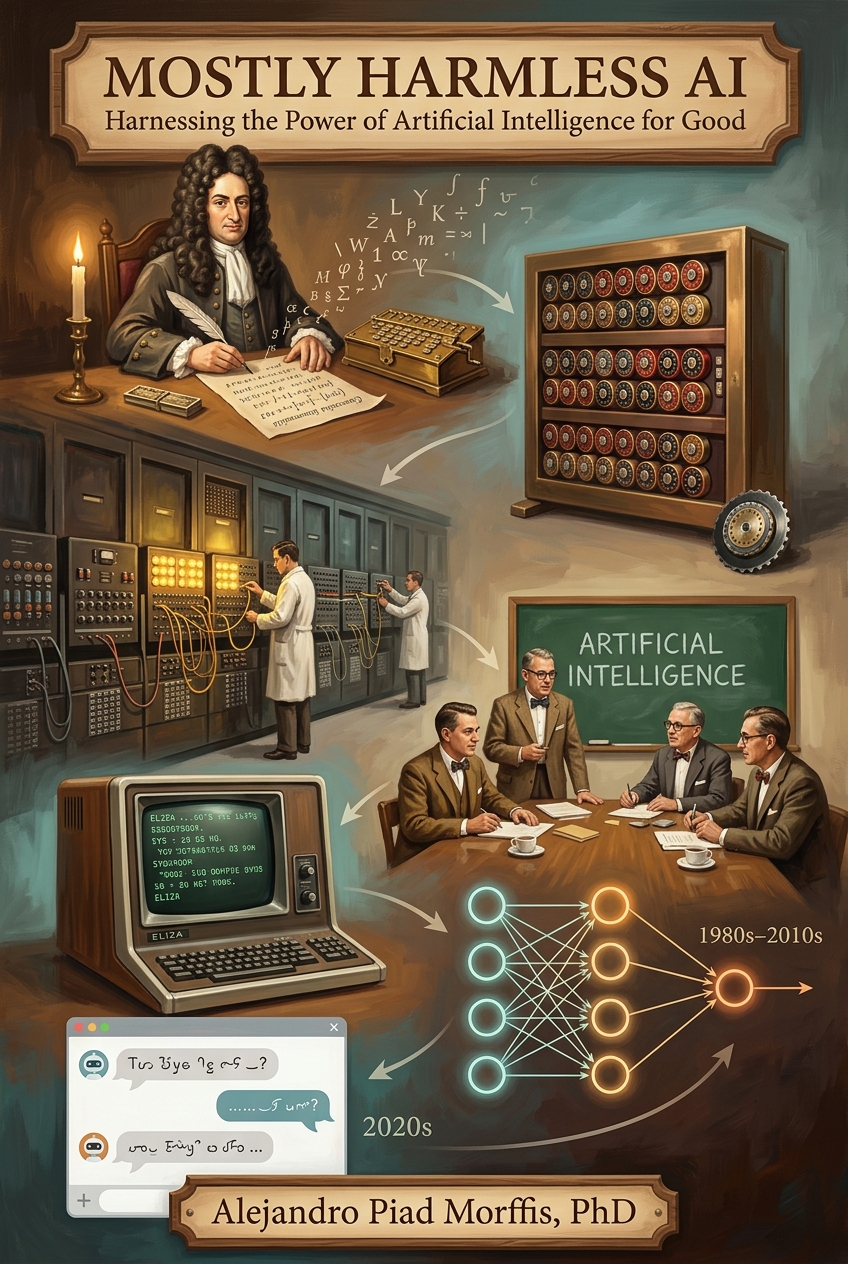
This is the second edition of Mostly Harmless AI. Most of it is new.
I rewrote it because the first edition, finished in late 2024, did not survive contact with 2026. The pace at which the field moved invalidated specific examples, specific tools, specific benchmarks — but it also invalidated the frame. The first edition was about an emerging technology. The book in your hands is about a technology that has emerged. Different question, different answers, different posture.
What is in it
The book is in three parts.
Part I explains how the technology actually works — not the marketing line, the actual mechanism. It walks the seventy-year argument between rationalist and empiricist AI, ends at large language models and agentic systems, and gives you enough of the substrate that the rest of the book is grounded in something other than analogy.
Part II is about what the technology is being used for now: knowledge work, science, software, education, creative production, policy. One chapter per domain, each written for the practitioner already in that field who wants an honest account of what these systems do well, what they do badly, and what to bet on.
Part III is about what can go wrong: alignment as a research problem, the limitations of current systems, and the real risks — bias, security, labour displacement, environmental cost, concentration of power. Not the doomerist version. Not the dismissive version. The third position.
Why I wrote it
I needed a book like this to hand to people who ask me what to read, and the book did not exist.
There are excellent textbooks, excellent journalism, excellent polemic. None of them are the kind of book I needed: the working researcher’s version, in plain English, with the technical scaffolding intact and the field’s own contradictions on the page rather than smoothed over. The textbooks are too narrow. The journalism is too breathless. The polemic is too sure of itself. So I wrote this one.
I am a machine-learning researcher and a professor; I built the first Cuban language model and I have spent the better part of a decade teaching this material to students who came in not knowing what a neural network was and left able to train one. The book is the thing I would hand a sharp newcomer who wanted the honest version. It is also, more selfishly, the thing I needed myself — the document I wished existed so I would not have to keep explaining the same arguments from scratch in conversation.
How to read it
Top to bottom is the default, and it works. The parts build on each other.
If you are short on time and want the practical core: skim the back half of Part I (LLMs and agents) and read whichever Part II chapter touches your field. If you want the philosophical argument: start with Part III, then come back to Part I for the mechanisms. The chapters are written to stand on their own; the glossary and the cross-references will hold the whole picture together either way.
What is new in this edition
Two structural additions you will notice immediately.
The glossary at the back of the book defines every named system, named technique, named person, and field-of-art term used in the body. Around four hundred entries. Every glossed term in the body is a clickable forward-link to its entry; every entry carries back-links to the pages where the term appears. The intent is that you can read this book at any depth without bringing specific prior vocabulary — and that when a term keeps appearing across chapters, the cross-references will show you the through-line.
The references apparatus has been rebuilt. Every paper, system, and benchmark cited in the body has a footnote with full citation; the footnotes are collected at the end and back-linked to the body. Where the original is online, the link points to the original — not a paraphrase, not a summary, not a third-party explainer.
Beyond those two, most chapters have been substantially rewritten and several are net-new — particularly in Parts II and III, where the field has moved most.
This book will not be finished
The field is in motion at a pace no static document can keep up with. Any version of this book will be wrong about some specific thing within six months of being printed.
The honest framing is that this is a permanent beta. Each edition is a snapshot of how the field looks from where I sit at the moment of writing. The next edition will fix what this one got wrong and add what this one missed. The cadence is roughly annual; the patience is the reader’s, and I am grateful for it.
On supporting the book
The book is free to read online at books.apiad.net. The PDF, the EPUB, and a few other niceties are on Gumroad for whatever you can afford.
If you got this copy from somewhere other than Gumroad and the book is useful to you, the work is worth supporting there. A one-time purchase gives you every future edition in perpetuity — no subscription, no expiring access, and there will not be either. If the price is a real obstacle, write to me at apiad@apiad.net and I will work something out. No one who wants to read this book should be unable to.
What your support actually funds: the time to keep rewriting the book as the field moves, the cost of the research that goes into each edition, and the next book.
On AI’s role in writing this book
I used AI heavily — for research, for outlining, for criticism, for refactoring chapters that were not landing. Some of the prose was first-drafted by a model and then rewritten in my voice; some was first-drafted by me and then critiqued by a model and rewritten again. Every idea, every argument, every conclusion is mine. Every sentence has been read, weighed, and either rewritten or kept by me deliberately.
This workflow is the one I argue for throughout the book. It would be dishonest to argue for it in print and not use it.
Where the book continues
The book stops at the page. The argument does not. Ongoing updates, errata, and the kind of essay that turns into the next edition’s chapter live at the Computist Journal, where I write weekly.
If you find something off while reading — a factual error, an argument that does not land, a topic that is missing — write to me. The next edition will be better for it.